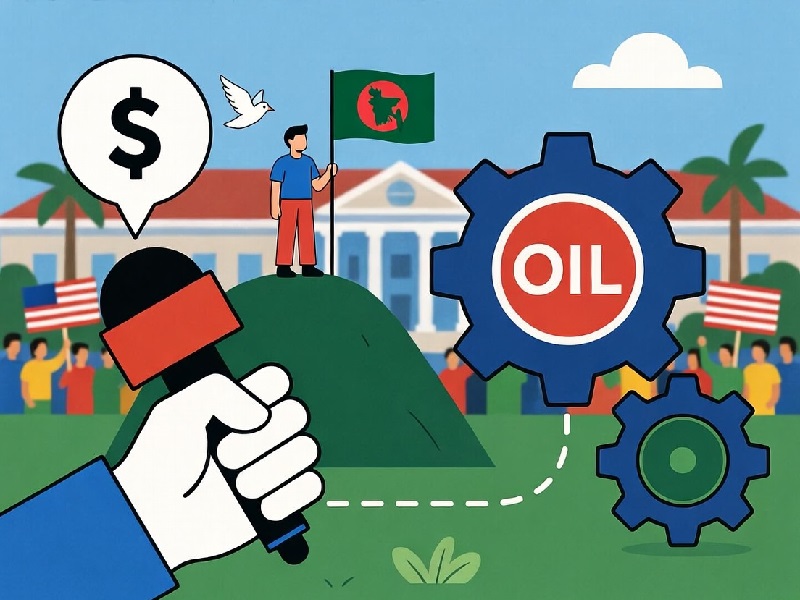
Canceling trade agreements with the United States shortly after assuming power would be neither feasible nor advisable for Bangladesh, particularly given that the new leadership has been in office for only about two weeks following the recent elections. To illustrate the potential consequences of abruptly repudiating such commitments, one may consider the historical examples of Iraq and Libya. Both nations faced severe devastation, widely attributed to U.S. military intervention following disputes over trade and resource policies—Iraq concerning oil sales and Libya regarding its rejection of the U.S. dollar in certain transactions.
A national election took place in Bangladesh just over a week ago. Prior to this, the country experienced a period of significant U.S. influence. The newly elected government now holds power, yet questions remain about the extent to which its leadership—many of whom spent nearly two decades in exile, often supported by Western entities—may still be swayed by foreign interests rather than prioritizing national sovereignty. It is hoped that the current administration will prove more independent than previous ones, which appeared overly aligned with external powers.
The following explains why canceling these deals at present would be unwise, while also acknowledging their imbalances and potential long-term drawbacks.
Bangladesh remained under substantial U.S. influence for approximately 17 months prior to the recent transition. During this period, various opaque activities likely occurred with the involvement of Western allies—some exposed, others perhaps concealed indefinitely. U.S. military personnel have been present in Bangladeshi cantonments under the guise of training, modernization, and other cooperative programs.In Bangladesh, the “American dream” holds strong appeal: many aspire to relocate to the United States with their families or send relatives there, as no local salary, government position, or illicit wealth can fully satisfy such ambitions. Individuals influenced or supported by U.S. military personnel may become highly motivated—even to the point of extreme actions. This dynamic could extend to senior military officials, law enforcement leaders, and those providing security protocols to the Prime Minister and ministers. Such entrenched influence renders any discussion of canceling U.S. deals highly risky. In a nation like Bangladesh, which struggles to sustain costly international commitments, the United States—its ostensible ally—need not resort to outright war; subtle sabotage or internal destabilization could suffice to upend the system rapidly.
Canceling the deals might become conceivable only if citizens mount widespread, non-political street protests. This approach could shift responsibility away from leaders, sparing them sole blame or retaliation. However, it would severely limit the options available to Western partners, potentially leading to extreme measures comparable to those observed in Gaza, but occurring in Dhaka. The entire population would bear the consequences, whether the deals are canceled or upheld. With hot summer approaching, prolonged blackouts could exacerbate vulnerabilities. Some actors may await the opportune moment to mislead the public and seize power, reminiscent of the July uprising—potentially involving the same figures previously rejected by the people. While these deals may not immediately devastate the economy this summer, their effects could manifest severely by the next.
The agreements carry notable disadvantages, some of which raise serious ethical concerns. U.S. oil is not always the highest quality on the global market; even if superior Venezuelan crude is supplied, it often stems from coercive acquisition, contributing to prolonged hardship for Venezuela’s population through shortages of food, clothing, and basic living standards while undermining its sovereignty. After Bangladesh’s decades-long struggle for independence and self-determination, importing such oil feels profoundly contradictory and disheartening. Moreover, sourcing oil from distant origins substantially increases import costs, rendering tariff-free exports less competitive overall. Military equipment procured from the United States often comes with stringent end-use restrictions, requiring prior notification or approval from the supplier. This limits independent utilization, undermining the value of such purchases—what purpose does payment serve for assets that cannot be freely operated? Finally, raw materials for garment exports to the United States (under preferential terms) may need to be imported from the U.S. itself, incurring higher transportation expenses than sourcing from proximate regional suppliers. This arrangement further erodes the economic benefits of the deals.
In summary, while these agreements exhibit clear asymmetries and moral qualms, abruptly canceling them now risks severe instability, internal sabotage, or worse. A more prudent course may involve careful renegotiation through sustained public pressure or diplomatic channels once the new government consolidates its authority and demonstrates genuine independence.
Monday, February 23, 2026 at 14:33:28
Vertyowdiwjodko kofkosfjwgojfsjf oijwfwsfjowehgewjiofwj jewfkwkfdoeguhrfkadwknfew ijedkaoaswnfeugjfkadcajsfn riflesquad.com