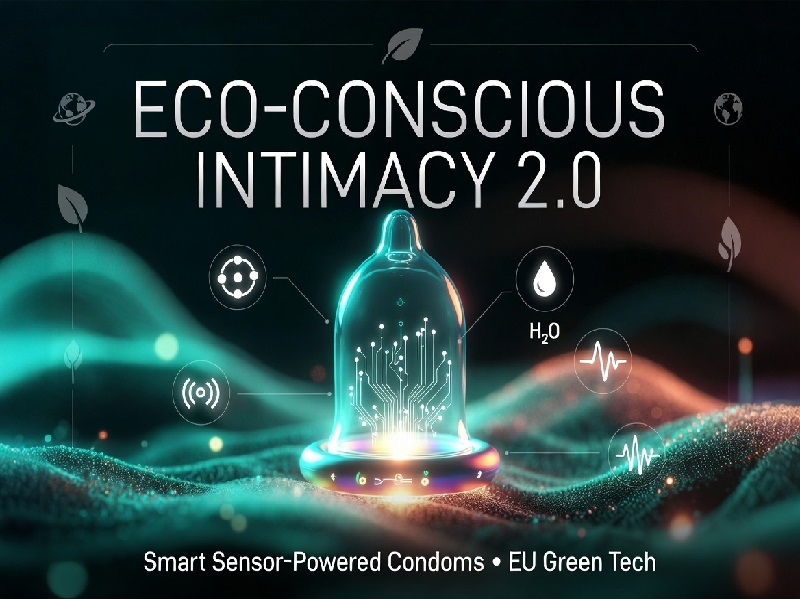
let’s talk about something that’s equal parts planet-saving science and bedroom revolution: the next wave of eco-friendly condoms tailored for the European Union. In a continent that’s all-in on the Green Deal and circular economy goals, traditional latex barriers are getting a serious upgrade. We’re not just swapping plastic wrappers for compostable ones anymore—we’re talking biodegradable bases fused with intelligent tech that reads the body’s signals in real time. It’s sustainability meets human physiology, turning protection into a shared, data-informed experience that feels good for both partners and the planet.
The Environmental Wake-Up Call (and Why Natural Rubber Is Leading the Charge)
Conventional condoms generate staggering waste—billions end up in landfills or oceans every year because many use synthetic lubricants, petroleum-based packaging, or non-biodegradable films. Natural rubber latex, harvested sustainably from Hevea trees, changes the game: it breaks down in under a year in the right conditions, unlike synthetic alternatives that linger for centuries.
Across the EU, forward-thinking brands are already paving the way. Glyde condoms—certified vegan, fair-trade, and made in worker-owned factories using locally sourced natural rubber—have been a staple since the early 2000s. Lovability’s hypoallergenic natural-latex versions are PFAS-free and fully biodegradable, with recyclable packaging. German-made lines like Natural Intimacy and Einhorn offset every gram of carbon in solar-powered factories, while Roam and Hanx deliver compostable wrappers that return to soil in weeks.
These aren’t niche novelties; they’re EU-compliant medical devices under the Medical Device Regulation (MDR 2017/745), carrying the CE mark while ticking every box in the new Ecodesign Regulation and Packaging & Packaging Waste Regulation (PPWR). No more hidden microplastics or deforestation-linked rubber—transparent supply chains are now table stakes.
Enter the Smart Revolution: Tech That Listens to Her Body
Now imagine layering cutting-edge biosensors onto that eco-latex foundation. The concept we’re seeing sketched out by forward-thinking EU innovators (building on early prototypes like the i.Con ring) is a tethered smart condom system: ultra-thin, 100 % biodegradable natural latex paired with a detachable, recyclable base module no thicker than a wedding band.
Here’s where the science gets exciting—and deeply social:
- Gyroscopic movement tracking: Tiny MEMS gyro sensors map thrust angle, speed, and rhythm in real time. Think Fitbit for intimacy—data that helps couples optimise endurance without guesswork, reducing fatigue and performance pressure.
- H₂O-level monitor: A non-invasive impedance or optical micro-sensor detects vaginal lubrication changes (essentially tracking transudate water content). Physiologically, rising moisture correlates directly with arousal and comfort; the system gently alerts via app or subtle feedback if dryness appears, suggesting a pause or extra lube—preventing discomfort before it happens.
- Muscle-plasm (myoelectric) detector: This is the game-changer. Using ultra-thin EMG-style electrodes, it reads electrical activity in pelvic-floor muscle fibres (the myoplasm—the living “plasma” inside muscle cells). Subtle contractions and tension spikes are the body’s honest language of pleasure and approaching climax. The detector translates these signals into actionable insights: “She’s building toward peak intensity.”
All of this feeds a compact vibration module and RGB lighting array. Low-level vibrations pulse in sync with her muscle-plasm patterns—ramping up or softening automatically to match her physiological needs. RGB LEDs shift colour (soft teal for relaxed connection, warm amber for building intensity, pulsing crimson at climax) creating a private light show that’s both beautiful and informative. The entire module is Bluetooth-tethered to a privacy-first EU app (GDPR-compliant, zero cloud storage of raw data unless you opt in). No creepy tracking—just anonymised session summaries you and your partner can discuss over coffee the next morning.
Because the electronics live in a detachable, recyclable ring (WEEE-compliant for responsible e-waste recycling), the latex condom itself remains fully compostable and chemical-free.
Why This Matters Socially and Scientifically
From a scientific standpoint, female arousal is still under-researched compared to male physiology. Tools like these close the data gap in real time, backed by decades of studies on pelvic-floor EMG and vaginal photoplethysmography. Couples report higher satisfaction when feedback loops replace guesswork—less “performance anxiety,” more mutual discovery. Socially, it’s about equity: pleasure becomes a shared language instead of a one-way street. In an era of consent culture and mental-health awareness, a condom that literally listens is powerful.
For the EU market, the timing is perfect. The Green Deal demands low-carbon, circular products; the MDR ensures rigorous safety testing (including biocompatibility and electromagnetic compatibility for the sensors). Brands could launch with carbon-neutral shipping, tree-planting offsets, and 10 % profits to sexual-health NGOs—exactly the model already used by Sustain Natural and Glyde.
The Future Is Already in Development
We’re not talking sci-fi anymore. Early sensor rings proved the hardware works; biodegradable latex is shelf-stable today; EU regulations are actively rewarding green innovation. The first tethered eco-smart condoms could hit EU shelves within 2–3 years—CE-marked, app-connected, and ready to turn every intimate moment into a sustainable, science-backed celebration of connection. So next time you reach for protection, you might just be holding tomorrow’s standard: something that protects bodies, pleasures partners, and respects the planet all at once. That’s not just a condom. That’s conscious intimacy—European style.