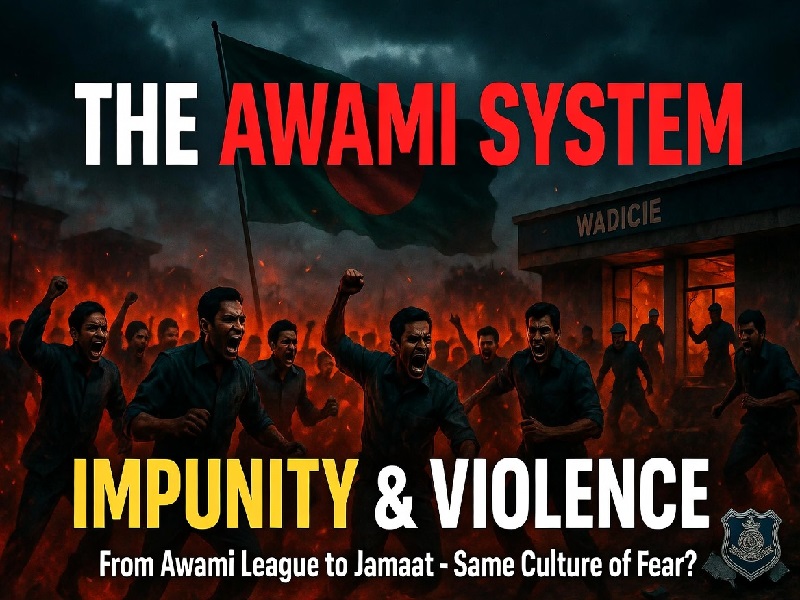
A few days ago, activists from Jubo Jamaat (the youth wing of Jamaat-e-Islami) allegedly stormed into Palashbari Police Station in Gaibandha district. They assaulted the Officer-in-Charge and several other police officers, injuring at least nine, including a female constable. The incident reportedly started over a complaint about a government-allotted shop. Instead of a peaceful resolution, it turned into a violent confrontation inside the station itself.
This was a deeply shameful event for Bangladesh. It exposed the weakness of state institutions and the growing sense of impunity among certain political groups. Reports indicate that while a case was filed and at least one local Jamaat leader was arrested in connection with the assault, the overall response highlighted ongoing challenges in maintaining law and order. No strong, immediate action from the party’s central leadership was widely visible to condemn or discipline the involved activists.
Police Vulnerability: From Bribes to Threats
Under the previous Awami League government (often called the “Awami system”), police were frequently silenced or controlled through money, political pressure, and patronage. Officers looked the other way on corruption, extortion, and abuses by ruling-party cadres. Today, a similar pattern appears to be emerging, but through different means: death threats, mob pressure, and direct attacks on police stations.
When law enforcers fear for their lives or hesitate to act against politically connected individuals, the entire justice system crumbles. If police officers inside their own station can be beaten with little consequence, ordinary citizens living in areas under the influence of such leaders have even less protection.
The Real Danger for Citizens
What happens tomorrow if the same individuals or groups escalate? What if they harass, rape, or kill ordinary people, settle personal scores through violence, or turn entire localities into no-go zones for dissent? This situation echoes the dark days of 1971, when Razakars (local collaborators with the government forces) terrorized Bengali civilians during the Liberation War. They acted with impunity, backed by government forces, committing atrocities while the state apparatus failed to protect the people.
The 1971 and July 2024 struggle was not just against foreign occupation or a dictatorship. It was a fight for dignity, sovereignty, and the rule of law — where no one, regardless of political or religious affiliation, stands above justice. Millions sacrificed their lives, not for cosmetic “reforms” that benefit one party or family, but for a Bangladesh where citizens are safe from both state tyranny and non-state thugs.
Hypocrisy on Corruption and the “Awami System” in New Clothes
Jamaat-e-Islami has long positioned itself as an anti-corruption force, criticizing money-driven graft and demanding moral governance. Yet critics argue that the party (and its allies) often seeks similar unchecked power — not through financial bribery alone, but through violence, mob attacks, intimidation, and threats. This is not genuine reform. It is the Awami System rebranded: a culture of impunity where the powerful (now from opposition to rulling) bend institutions to their will, while ordinary people pay the price.
Existing laws already exist to punish assault, extortion, and threats. The problem is not the absence of laws, but their selective non-application when politically inconvenient. If a leader or activist feels above the law today, “reforms” alone will not magically change that behavior unless there is political will to enforce accountability across the board — without favoritism toward any group, whether Awami League remnants, BNP, Jamaat, or others.
What the Government and People Must Do
The current elected government and any future elected government face a clear test: Can they restore the authority of the state so that police can do their job without fear? Will they apply the same standards of justice to all political actors, including those waving religious or anti-corruption banners?
The people of Bangladesh did not shed blood in 2024 to replace one form of authoritarianism or lawlessness with another. True change requires ending the culture where party cadres — from any side — treat police stations like personal battlegrounds and citizens like subjects in their fiefdoms.
Bangladesh deserves institutions that serve the public, not political masters. It deserves leaders who condemn violence by their own supporters as loudly as they criticize their opponents. Without that, the “Awami System” will simply wear new masks — whether secular, nationalist, or Islamist — while the cycle of fear and impunity continues.
The real victory of the liberation spirit and the 2024 uprising will come only when no one — no party, no leader, no mob — can beat the law inside a police station and walk away unscathed. Until then, ordinary citizens remain the biggest victims.