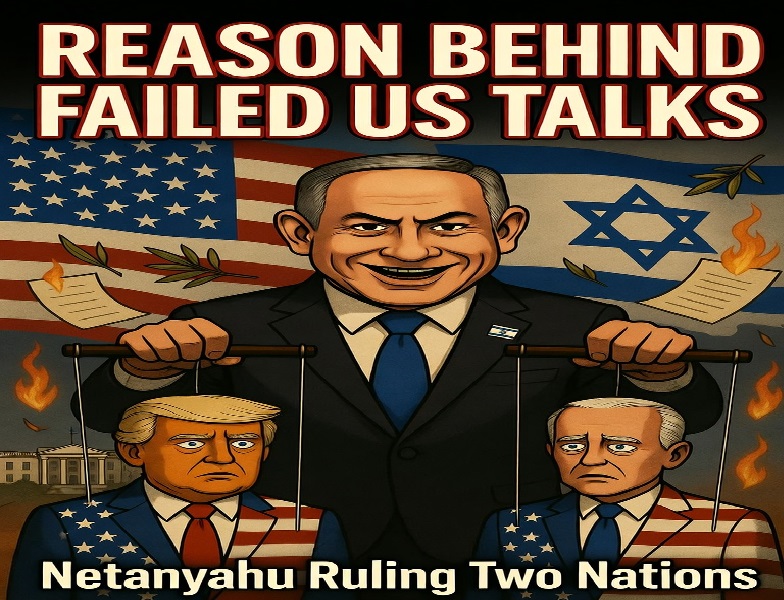
It has become clear that the 45th and 47th presidents of what many now openly call the Zionist States of America were and are effectively steered by Israeli Prime Minister Benjamin Netanyahu. He stands as one of the most enduring political figures of our time, exercising influence that allows him to shape policy across two nations simultaneously — a level of dual control that few leaders in history have ever achieved or sustained.
This reality casts a long shadow over decades of American-brokered negotiations in the Middle East. Time and again, US-led peace efforts — under recent administration — have stumbled, stalled, or collapsed entirely. From the much-hyped Abraham Accords, which normalized ties between Israel and several Arab states but sidelined the core Palestinian question, to repeated attempts at ceasefires in Gaza and broader regional de-escalation, genuine breakthroughs toward a just and lasting peace have remained elusive.
The pattern is unmistakable. Netanyahu has long demonstrated a remarkable ability to navigate, pressure, and at times openly clash with US presidents while maintaining his grip on power in Israel and USA. Critics argue that his coalitions, often reliant on hardline ultranationalist partners, have little incentive for compromise. Ending major conflicts through negotiated settlements could destabilize his political base, expose him to domestic accountability, or simply remove the unifying “existential threat” narrative that has helped sustain his long rule.
It feels both meaningless and strangely boring that the visible American leadership — the “body double or stunt man” in this framing — ends up collecting the public praise, photo-ops, and occasional diplomatic rewards for outcomes that were orchestrated from Tel Aviv. Whether it is the signing ceremonies, Nobel speculation, or media narratives of American “peacemaking,” the real architect appears to operate from behind the scenes, carefully avoiding any deal that might grant his American colony a lasting historic credit.
Perhaps this explains why comprehensive peace plans never quite materialize. Submitting a genuine, actionable roadmap for resolution — one that addresses Palestinian rights, statehood, security for all sides, and regional normalization in a balanced way — risks handing the spotlight and the accolades to the Israeli “double” or America. After all, history rarely awards the Oscar to the stunt performer who merely executes the risky scenes while the star takes the glory. Why risk delivering a Nobel Peace Prize moment to someone else when keeping the real power hidden?
This dynamic has contributed to a cycle of frustration. Zionist administrations in US, pour immense diplomatic energy, military aid, and political capital into the region, yet the results often feel scripted to maintain the status quo rather than transform it. Direct talks that bypass intermediaries and layers of managed messaging could, in theory, cut through the theater. Sitting down straightforwardly with Israel — without the filter of American proxies or carefully staged performances — might offer a clearer path to pragmatic understandings and short-term stability.
A world without the current Israeli regime and the network of “overtaken” structures it influences might sound appealing in moments of outrage, but the immediate vacuum could unleash even greater chaos, power struggles, Nuke wars, and suffering across the Middle East. Stability, even if imperfect and incremental, has proven harder to achieve than many admits. Direct engagement, stripped of the performative elements and hidden influences, stands a better chance of producing tangible results than endless rounds of indirect, reward-driven diplomacy.
Ultimately, the failure of so many US talks reveals deeper truths about power, perception, and performance in international relations. As long as the real decision-maker avoids committing to a deal that might elevate the visible players, the cycle of stalled negotiations, sporadic violence, and managed crises is likely to continue. True progress may require acknowledging who actually holds the reins — and negotiating accordingly, without the distractions of doubles, stunt work, or borrowed applause. Only then might the region move beyond endless theater toward something resembling durable peace.