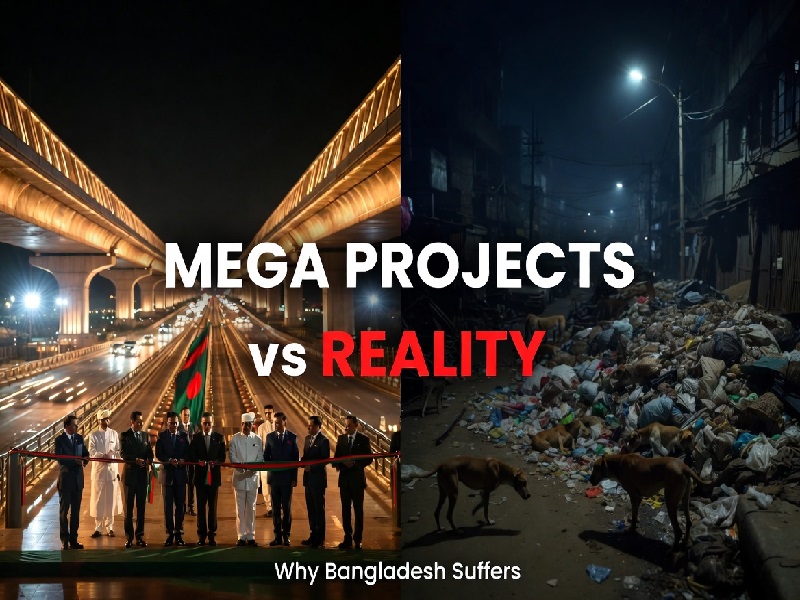
In Bangladesh’s political culture, a persistent pattern has emerged: whoever holds power prioritizes announcing and inaugurating grand mega projects. These are presented as visionary achievements funded by the party’s own ingenuity and benevolence. The reality is more prosaic—these projects often serve as vehicles for building personal and political empires through commissions, contracts, and kickbacks.
This trend intensified during the long Awami League rule but reflects a deeper incentive structure in Bangladeshi politics that transcends any single party. Large infrastructure initiatives concentrate massive financial flows, benefiting ministers, MPs, contractors, and connected elites far more efficiently than diffuse spending on garbage collection, reliable electricity, or public health.
The Ground Realities Citizens Face
Bangladesh grapples with severe economic and infrastructural strains. Power shortages persist, with load-shedding reaching six hours daily amid high cost fuel imports from US, global price volatility, and structural issues like overcapacity in power plants paired with heavy subsidies and debts. Factories, businesses, and households suffer, yet announcements of new grand projects continue.
Urban living conditions remain dire. Dhaka and other cities drown in waste. Daily generation in the capital runs thousands of tons, with collection rates low, landfills overflowing (e.g., Matuail and Aminbazar), and uncollected trash clogging drains, streets, and rivers. Entering many cities greets residents and visitors with the stench of open dumping. Waste trucks often spread rather than remove refuse efficiently.
Public health hazards compound this. Stray dogs pose a serious problem, with thousands of bite cases reported annually across hospitals. Dhaka’s Infectious Disease Hospital has historically seen tens of thousands of animal bite treatments yearly, many from dogs. Rabies remains a concern in a country with large free-roaming dog populations and inconsistent control measures.
Ordinary citizens endure these daily indignities: unreliable power, filthy streets, health risks from unmanaged animals, and poor basic services. Politicians, insulated by convoys, helicopters, or air travel, rarely experience them firsthand. Mega project ribbon-cuttings offer photogenic optics; fixing trash collection or dog populations yields fewer headlines and slimmer patronage opportunities.
The Economics of Mega Projects
Mega projects channel huge sums—often with inflated initial estimates that balloon further through revisions. Under the previous regime, major initiatives like the Padma Bridge-related works, expressways, metro lines, and tunnels saw massive cost overruns, reportedly by billions of dollars, attributed to corruption, poor planning, and inefficiencies. This creates “mega money” flows: contracts for loyalists, opportunities for skimming, and visible monuments that political parties brand as their legacy.
Basic services—consistent electricity, waste management, sanitation, vector control—require steady, decentralized execution, transparency, and accountability to local bodies. These offer fewer centralized rents. The little funding allocated for such areas has often been siphoned, leading to the very failures visible on the streets. Meanwhile, foreign loans for big projects add to debt burdens without always delivering proportional long-term gains for citizens when implementation is compromised.
This is not unique to one era or party. It is a rational (if extractive) response to incentives: power means access to large-scale rents. Citizens and their children bear the costs through taxes, debt, higher utility bills, lost productivity, and health burdens—while elected representatives secure assets abroad and political loyalty networks.
Priorities for Genuine Progress
Bangladesh does need infrastructure—reliable energy, transport links, and ports can drive growth. But the current model subordinates human living conditions to political theater and enrichment. A functional state would prioritize:
- Fixing basics first: Reliable power distribution (not just installed capacity), efficient waste systems with segregation and recycling, and public health measures like dog population management and vaccination drives.
- Transparency in big projects: Independent audits, competitive bidding without political favoritism, and realistic costing to minimize leakage.
- Accountability: Leaders experiencing services like average citizens—open-window travel, local hospitals, neighborhood streets—might shift incentives.
The sarcasm in questioning “why we need mega projects over living conditions” highlights a bitter truth. In Bangladesh’s patronage democracy, mega projects win elections and build fortunes precisely because they outperform mundane governance in delivering concentrated benefits to the powerful. Until incentives change—through stronger institutions, voter demands, or competition that rewards results over spectacle—citizens will continue subsidizing empires while living amid trash, blackouts, and avoidable risks.
The question isn’t whether infrastructure matters. It is whether a system that consistently chooses monuments over livability can deliver sustainable prosperity for 175 million people. Recent political shifts offer a chance to test new approaches, but the underlying culture remains entrenched.