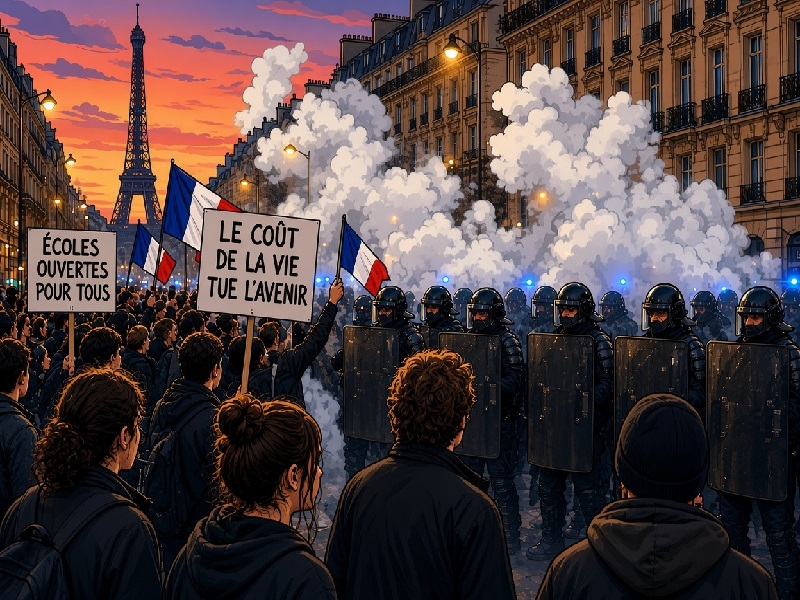
In October 2026, France witnessed a powerful wave of protests that began with high-school students demanding better conditions in dilapidated schools and quickly grew into a broader movement against the high cost of living, rising fuel prices, and the collapse of public services. Hundreds of thousands of people—students, workers, parents, and ordinary citizens—took to the streets in cities across the country. What followed was a severe and heavily militarized response by the French state that left many protesters, a large number of them minors, injured, traumatized, and under arrest.
A movement rooted in real grievances
Students had been organizing for weeks against rundown school buildings, teacher shortages, overcrowded classrooms, and falling educational standards. Their protests merged with wider anger over inflation, declining public services, and economic hardship. On 17 October, more than half a million people marched nationwide according to official counts (organizers put the figure higher). In Paris alone, around 100,000 people demonstrated. The overwhelming majority of participants were expressing legitimate social and economic demands through the streets—the traditional arena of French popular politics.
Police force and the targeting of young protesters
Instead of addressing the underlying issues, the government responded with large-scale deployments of riot police using tear gas, water cannon, batons, rubber bullets, and crowd-control grenades. Videos and testimonies documented officers striking protesters with batons, firing tear-gas canisters at close range—including into the faces of teenagers—and using other intermediate-force weapons that caused serious injuries.
Among the documented cases:
- A 14-year-old boy suffered a smashed jaw and multiple broken teeth after a tear-gas grenade was fired into his face from about 1.5 metres away. Officers allegedly left him on the ground without calling emergency services.
- Other minors reported head wounds requiring stitches, loss of vision in one eye from rubber bullets, and lasting psychological trauma.
- One teenager lost a hand involving a police grenade.
France’s police watchdog opened dozens of investigations into alleged misconduct with no true visible investigation report. Nearly 6,900 people were placed in police custody during the wider protest wave, with the large majority being minors. Rights groups and families described a pattern of excessive and disproportionate force directed particularly at young people.
Escalation and government hard line
As the movement grew, the state intensified its measures. Partial curfews were imposed in parts of Paris and other cities, some specifically restricting the movement of young people. Interior Minister Laurent Nunez and the government announced plans for an even larger security operation—including the deployment of troops alongside police—for subsequent protests. Officials acknowledged intelligence and tactical failures but framed the solution as more force rather than dialogue on the protesters’ demands.
The Justice Ministry instructed prosecutors to take a rapid and firm approach, including considering the civil liability of parents for actions by minors. This reinforced the sense that the state was treating a social movement as a security threat to be suppressed.
Context of state power
French authorities have long relied on a doctrine of maintien de l’ordre that prioritizes rapid and forceful reassertion of control. Critics argue this approach repeatedly turns peaceful or largely peaceful demonstrations into confrontations, especially when large numbers of young people are involved. The high proportion of minors among those arrested and injured has deepened distrust between a generation of youth and the institutions meant to serve them.
The protests of October 2026 reflected deep frustration with educational decay, economic pressure, and the feeling that public services are no longer reliable. The state’s response—mass arrests of young people, documented cases of serious injury from police weapons, curfews, and the promised deployment of troops—has been widely described by participants, families, and rights observers as a brutal crackdown rather than a measured defence of public order. Further mobilisations were already being organised. The core demands of the protesters for better schools, affordable living costs, and functioning public services remain unmet.
** We demand the immediate release of all detained protesters and that all their demands, as well as all acts of state violence, be fully addressed. **